The Bulgarian Diplomatic Institute has accumulated solid administrative experience and expertise in the preparation and management of projects with national, European, and international funding and importance
The projects implemented by the Bulgarian Diplomatic Institute in the fields of training, research, and public policy constitute an integral part of fulfilling our mission and contribute to strengthening our national and international standing. Over the years, the Institute has been the beneficiary of numerous European and internationally funded initiatives, ranging from specialised training programmes for public administration to communication campaigns. Their thematic focus has encompassed a broad spectrum of areas, including European affairs, soft skills, energy diplomacy, regional cooperation, good governance, and development policy.
Among the large-scale projects implemented by the Bulgarian Diplomatic Institute since 2010 are:
Since 2018, the Bulgarian Diplomatic Institute has been implementing a series of four consecutive two-year projects funded under the Bulgarian Official Development Aid programme. The projects aim to strengthen the administrative, managerial, expert, technical, information, and analytical capacity of the Diplomatic Institute of the Republic of Moldova. The initiative includes the exchange of expertise, training of trainers, the co-organisation of public events, and the provision of technical and material support. The direct beneficiary of the project is the Diplomatic Institute of the Republic of Moldova. Indirectly, the project also targets external lecturers, members of the Moldovan Diplomatic Service and public administration, as well as other key stakeholder groups engaged in the Institute’s activities, including representatives of civil society, academia, non-governmental organisations, and the business community.
An international project currently being implemented for the fifteenth consecutive year, funded under the Bulgarian Official Development Aid (ODA) programme. The project aims to enhance the professional capacity of public officials working in the fields of energy, economy, and climate policy from the Western Balkans and the Black Sea–Caspian region. It also seeks to strengthen and expand cooperation at the international, regional, and European Union levels on issues related to energy security and infrastructure development, climate change mitigation, the transition to a competitive and sustainable economy, and the implementation of EU regulatory policies in the fields of energy and climate. The project equips participants with practical experience and key competencies to help them address emerging challenges in the energy sector more effectively. The project comprises four main components: a specialised seminar featuring Bulgarian and international experts; a regular publication covering current developments and emerging trends in energy diplomacy; an expert panel addressing specialised topics such as industry, technology, competitiveness, and regional connectivity; a complementary forum dedicated to promoting the objectives and achievements of the Bulgarian Official Development Aid programme.
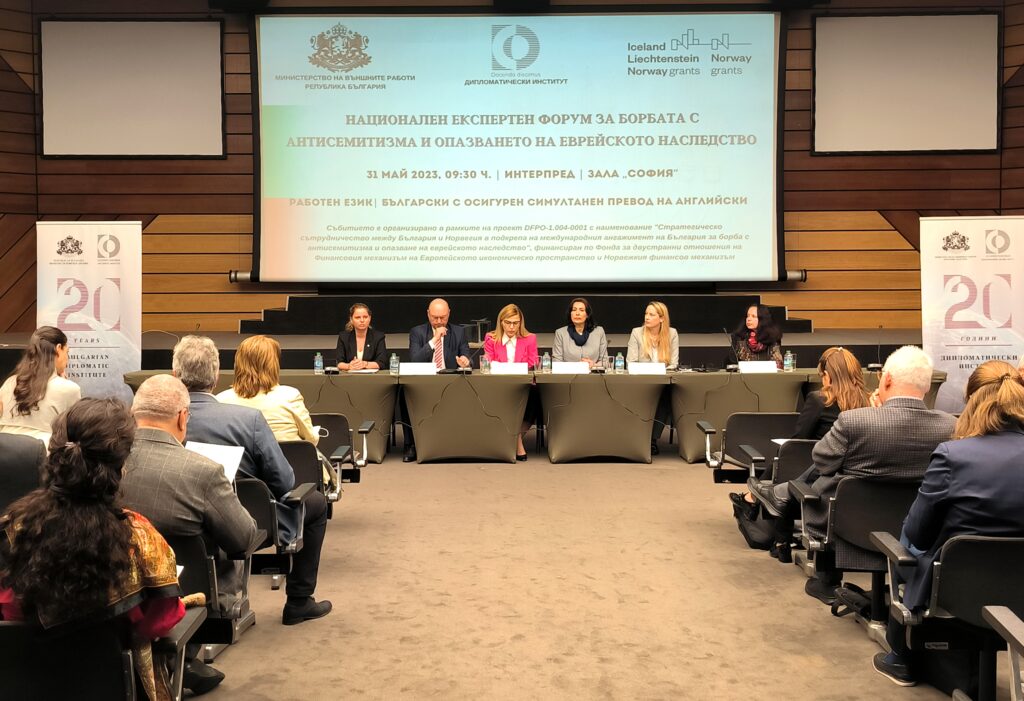
A two-year project (2021–2023) implemented in partnership with the Ministry of Foreign Affairs of the Republic of Bulgaria, the State Institute for Culture, and the Norwegian Center for Holocaust and Minority Studies. The project was funded through the Bilateral Relations Fund under the EEA Financial Mechanism and the Norway Grants. The initiative supported Bulgaria’s commitments as a member of the European Union and the International Holocaust Remembrance Alliance (IHRA) by promoting the integration of measures to prevent and combat antisemitism into relevant national strategic documents and action plans. Particular emphasis was placed on the development and initial implementation of the first National Action Plan for Combating Antisemitism of the Republic of Bulgaria.
A one-year project (2024) implemented in partnership with the Bulgarian Platform for International Development. The project was carried out under the Good Governance Operational Programme and aimed to contribute to the open and accountable governance of Bulgaria’s international development cooperation policy. Its specific objectives included strengthening cooperation between civil society organisations and public institutions to ensure regular and transparent reporting on programmes and projects funded through Bulgaria’s Official Development Aid (ODA); improving the legal and institutional framework governing Bulgaria’s international development cooperation policy; increasing stakeholder engagement through an active information campaign highlighting achieved results; and raising public awareness of the role of international development cooperation as an integral component of Bulgaria’s foreign policy.
Following the designation of 2015 as the European Year for Development (EYD 2015) by the European Parliament and the Council of the European Union, the European Commission invited Member States to apply for funding under a dedicated grant scheme through national programmes designed to achieve the objectives and expected outcomes of the initiative. The Ministry of Foreign Affairs of the Republic of Bulgaria and the Bulgarian Diplomatic Institute jointly developed Bulgaria’s National Programme of Activities. The Ministry of Foreign Affairs was appointed National Coordinator, while the BDI served as the National Beneficiary. Between January and December 2015, the BDI implemented — independently and in cooperation with the Ministry of Foreign Affairs, civil society organisations, academia, and the private sector — a wide range of initiatives aimed at communicating the key messages of the European Year for Development to the project’s target audiences. The programme’s principal activities included public and expert events, a national essay competition, two nationwide sociological surveys, information and media campaigns, as well as the preparation and publication of specialised editions and information materials.
A three-year project (2020–2022), funded under the Good Governance Operational Programme 2014–2020, co-financed by the European Union through the European Social Fund. The main objective of the project was to develop, enhance, and modernise the specific knowledge, skills, and competencies of employees in the central state administration. The first specific objective of the project was achieved through the implementation of a large-scale and intensive comprehensive training programme targeting employees of the central state administration. The training courses covered topics such as protocol and etiquette, public diplomacy, communication and presentation skills, as well as specialised English terminology related to European and international affairs. The second specific objective was achieved through targeted measures aimed at strengthening and modernising the expert, administrative, and institutional capacity of the Bulgarian Diplomatic Institute. This included specialised training programmes for the Institute’s employees in EU Member States, contributing to the enhancement of both the general and specialised capacity of the beneficiary institution.
A three-year project (2016–2018), funded under the Good Governance Operational Programme 2014–2020, co-financed by the European Union through the European Social Fund. The project aimed to prepare the team of the first Bulgarian Presidency of the Council of the European Union (2018) by developing expertise related to effective cooperation with European institutions. Within the framework of the project’s overall objective to improve governance in the Bulgarian central administration and enhance the specialised qualifications of public administration representatives in the field of European policy coordination, the project included the following activities: organisation of training courses to improve negotiation, communication, and presentation skills, accompanied by the development of training materials; internships in EU institutions and Bulgaria’s Permanent Representation to the EU in Brussels; training courses in EU terminology in English; development and introduction of new specialised training programmes and methodologies within the Bulgarian Diplomatic Institute’s training activities; capacity-building training for employees of the BDI aimed at strengthening the institution’s administrative capacity; information and communication activities.
A two-year project (2017–2018), funded under the U.S. Department of State’s Emerging Donors Challenge Fund programme. The project included seminars held at six universities in four Ukrainian cities — Kyiv, Kharkiv, Lviv, and Chernivtsi — with the participation of distinguished diplomats, energy experts, and lecturers from Bulgaria. The main objective of the project was to raise awareness among Ukrainian society, and particularly among Ukrainian university students, about EU requirements in the energy sector, as well as to familiarise participants with best practices for developing effective energy systems and with the European Union’s energy policy. The project also included expert discussions with representatives of Ukraine’s public and private sectors whose activities are related to the thematic areas addressed by the initiative. More than 800 Ukrainian students participated in the seminars. The project contributed to strengthening the reputation of the Bulgarian Diplomatic Institute as a leading Bulgarian institution providing specialised training and conducting research in the fields of energy and climate diplomacy, as well as EU energy policy.
A two-year project (2011–2013), implemented with the support of the Hanns Seidel Foundation, comprising seminars in the Western Balkan countries aimed at sharing Bulgaria’s experience in the process of EU accession. The project had a regional scope and, in addition to Bulgaria, included the following beneficiary countries: the Republic of Serbia, Montenegro, Bosnia and Herzegovina, and the Republic of North Macedonia. The project consisted of four separate training seminars organised by the Bulgarian Diplomatic Institute in each of the four beneficiary countries. The seminars followed a similar structure, content, and expected outcomes. The target group included senior-level public officials responsible for European integration, regional cooperation, and economic development issues. Particular emphasis was placed on the role and responsibilities of national administrations in managing and accelerating the European integration process. The main outcome of the project was the development of a trained group of professionals familiar with the challenges faced on the path towards EU accession and with the methods and approaches used by Bulgaria to address them.
A long-term project (2014–2025) featuring exhibitions in Bulgaria and abroad of historical maps that capture the spirit of the Black Sea region and contribute to new understandings of its contemporary significance as a border region of the European Union. The main objectives of the project were to contribute to regional and international cooperation and to present the Western Black Sea coast as an integral part of Europe’s cultural space. Within the framework of the project, a number of exhibitions were organised on the occasion of significant events, including: the International Year of the Map (New York); Bulgaria’s National Day – 3 March (Paris); European Days (Tbilisi); the 120th anniversary of Bulgarian–Iranian diplomatic relations (Tehran); the 25th anniversary of Black Sea Economic Cooperation (Burgas); Bulgaria’s Chairmanship of the Black Sea Economic Cooperation Organisation (BSEC) in 2019 (Istanbul). The long-standing curator of the exhibitions was Svetlozar Kovachev† (1958–2025).
A communication campaign launched in connection with the 2014 elections for the European Parliament, implemented as part of the National Communication Strategy of the Republic of Bulgaria for the European Union. The main objectives of the campaign were to increase Bulgarian citizens’ awareness of their European rights, with a particular focus on electoral participation; provide information about the functions and role of EU institutions; encourage citizens’ involvement in European debates; and promote positive attitudes towards Bulgaria’s membership in the European Union. The activities implemented within the framework of the project included online platforms, a video competition, public debates, quizzes, public events marking Europe Day, and publications.
The Bulgarian Diplomatic Institute is always looking for new opportunities for institutional cooperation and implementation of projects relevant to the Bulgarian diplomatic service and state administration.
